
Acroview technology
Understanding the Bathtub Curve in AI Power Module Reliability
As AI computing platforms continue to increase in power density, ensuring reliable power delivery has become a fundamental engineering challenge. High-performance AI servers operate under significantly higher electrical and thermal stress than conventional computing platforms, placing increasing demands on their power modules throughout the product lifecycle.
One of the most widely used concepts in reliability engineering for evaluating long-term product performance is the Bathtub Curve. It describes how failure rates evolve over time and provides a practical framework for understanding product reliability—from manufacturing through end-of-life.
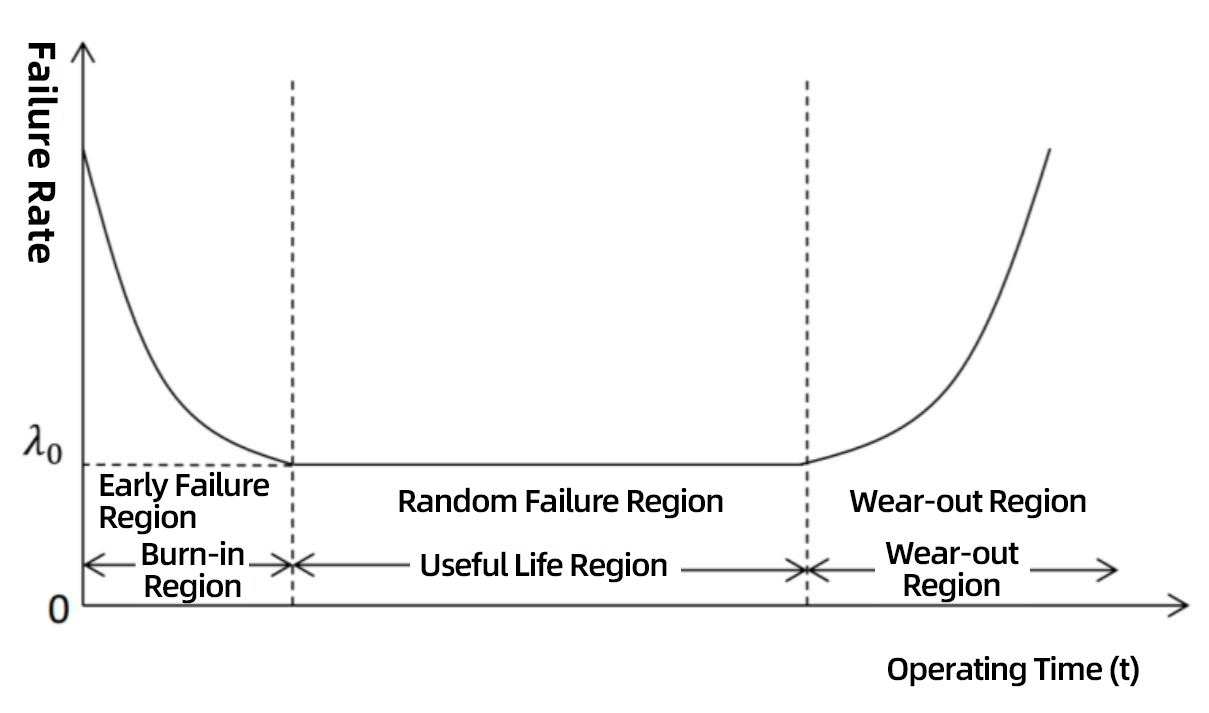
(Figure 1: Bathtub Curve of Failure Rate Over Operating Time in Reliability Engineering)
For AI power modules, this model offers valuable insight into how manufacturing quality, operating conditions, and component aging collectively influence service life.
The Bathtub Curve in Reliability Engineering
The Bathtub Curve illustrates how a product's failure rate changes throughout its operational lifetime. The characteristic shape consists of three distinct phases: an initial period of elevated failures, a long interval of relatively stable operation, and a final stage where wear-out mechanisms drive failure rates upward.
Early Failure Period
Failure rates are highest immediately after manufacturing due primarily to latent production defects, material inconsistencies, or assembly imperfections that escaped initial inspection.
To reduce field failures, manufacturers commonly perform burn-in testing, operating power modules under elevated temperature and electrical stress before shipment. This screening process helps identify units with early-life defects so that only stable products proceed to deployment.
Useful Life
Following burn-in, products enter their longest operational phase, during which failure rates remain relatively low and statistically stable.
Failures occurring during this period are typically random rather than age-related, often resulting from external events such as electrical disturbances or abnormal operating conditions rather than intrinsic component degradation.
Wear-Out Period
As operating hours accumulate, aging mechanisms gradually become dominant. Material fatigue, component degradation, and long-term thermal stress increase the likelihood of failure, marking the transition into the wear-out phase where reliability begins to decline more rapidly.
Why AI Power Modules Experience Greater Reliability Challenges
While the Bathtub Curve applies broadly to electronic products, AI server power modules operate under significantly more demanding conditions than those used in conventional computing systems.
Highly Dynamic Power Consumption
AI workloads generate rapidly changing power demand. During inference or training, electrical load may transition from low utilization to full or near-full load within milliseconds before dropping again just as quickly.
These repeated load transients create continuous thermal cycling inside the power module. Frequent expansion and contraction of internal materials introduce mechanical stress that accumulates throughout the product's operating life.
Accelerated Thermal Fatigue
Thermal cycling is one of the primary wear-out mechanisms affecting power electronics.
Repeated temperature fluctuations can gradually fatigue internal interconnect structures, including aluminum bond wires, leading to crack formation and eventual electrical failure. At the same time, prolonged exposure to elevated temperatures accelerates capacitor aging and other temperature-dependent degradation mechanisms.
Collectively, these effects can shorten the stable operating period predicted by the Bathtub Curve and accelerate entry into the wear-out phase.
Improving Reliability Throughout the Product Lifecycle
Maintaining high availability in AI infrastructure requires strategies that address both early-life defects and long-term degradation. Current industry practice combines mature system-level reliability techniques with emerging predictive maintenance approaches.
Burn-In Screening
Burn-in remains a fundamental reliability screening process for identifying latent manufacturing defects before deployment. By eliminating weak units during production, manufacturers reduce the likelihood of early field failures and improve overall product quality.
Redundant Power Architectures
Modern data centers commonly employ redundant power configurations, such as N+1 or 2N architectures.
By incorporating backup power modules, these designs allow the system to continue operating even if an individual power supply fails, minimizing service interruption and improving overall system availability.
Predictive Maintenance
Reliability management is increasingly shifting from reactive replacement toward condition-based maintenance.
At the equipment level, IoT-enabled monitoring systems continuously collect environmental and operational parameters—including temperature, humidity, and system voltage—to detect abnormal operating conditions before they develop into failures.
At the semiconductor level, however, directly monitoring internal degradation remains considerably more challenging because highly integrated power devices offer little physical space for embedded sensing.
To address this limitation, ongoing research is investigating load-based predictive models. Rather than directly measuring internal material degradation, these approaches analyze high-speed current profiles collected through Power Management ICs (PMICs) to characterize electrical stress experienced during AI workloads.
Machine learning techniques are then used to correlate recurring load patterns with known fatigue mechanisms, such as bond-wire degradation, with the objective of estimating remaining useful life (RUL) before physical failure occurs.
Although such chip-level predictive algorithms remain an active area of research rather than widespread commercial deployment, they represent a promising direction for future reliability management in AI power systems.
Conclusion
The reliability of AI power modules extends well beyond component design alone. It depends on reliability practices applied throughout the entire product lifecycle—from manufacturing screening and system-level redundancy to predictive maintenance technologies under active development.
As AI systems continue to increase in power density and computational scale, reliability engineering will remain essential to achieving long-term power system availability.
- Previous: Vertical Power Delivery (VPD) in AI Systems
- Next: No More!

- 7F, Hanking Center (SOMA) 9968 Shennan Avenue, Nanshan Dist, Shenzhen, 518052, P.R.C
- sales@acroview.com